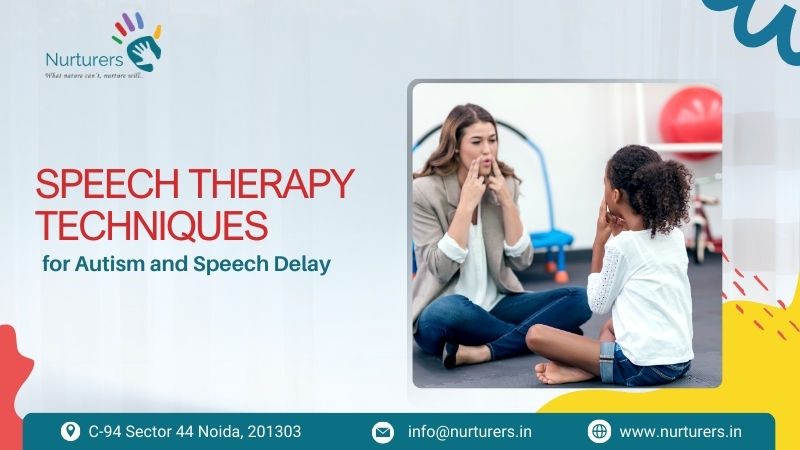
Speech therapy is essential for helping children with Autism and Speech Delay develop meaningful communication, clearer speech, and better understanding of language. Every child learns differently, so therapy focuses on improving both receptive language (understanding words, sounds, and instructions) and expressive language (speaking, making sounds, forming words, and using gestures). Through regular sessions, playful interactions, and structured language practice, children learn to express their needs confidently and communicate more effectively in daily life.
Therapists mainly use techniques such as Play-Based Speech Therapy, Language Stimulation Techniques, Articulation Therapy, Oral-Motor Exercises, Imitation & Modeling Techniques, and Social Communication Support. These methods help children build vocabulary, improve clarity, enhance eye contact, and develop better sentence formation. With consistent therapy and parental involvement, children gradually show improvement in communication, behavior, and social interaction—making everyday communication smoother and more meaningful.
1. Structured Communication Environment
A stable and predictable environment is essential for children with autism due to their need for routine and clarity. In therapy sessions, the environment is arranged with:
- Clearly defined activity areas
- Minimal sensory distractions
- Fixed transitions between tasks
- Visual cues for expectations
This arrangement strengthens the child’s ability to attend, reduces behavioural overwhelm, and increases cognitive availability for communication tasks. The structured setup also ensures the child can anticipate what will happen next, which significantly improves engagement and cooperation.
2. Advanced Use of Visual Supports and AAC
Visual-based communication systems are widely recognized as highly effective for autistic learners. At Nurturers, visuals are not limited to basic PECS; they include a range of professionally applied supports:
• PECS (Phases I–VI)
From picture exchange initiation to structured sentence building, children are gradually trained to request, comment, and respond using picture-based language.
• Visual Schedules
Daily routines are broken down into visual sequences, enabling children to process transitions with fewer behavioural challenges.
• First–Then Structures
Used to establish behavioural predictability and support cooperative communication.
• AAC (Augmentative and Alternative Communication)
Includes symbol-based communication boards, core word boards, and speech-generating devices. AAC is introduced through a systematic plan, ensuring it complements—rather than replaces—verbal development.
These tools provide a stable reference point that helps children understand information and participate more independently in communication.
3. Language Modeling With Developmentally Aligned Input
Professional speech therapists modify their language to match the child’s developmental stage. Techniques include:
Self-talk and parallel-talk – The therapist describes their own actions (self-talk) or the child’s actions (parallel-talk) using clear, functional vocabulary. This exposes the child to meaningful words in real time, supports vocabulary learning, and strengthens receptive language skills.
Reduced language load – Therapists intentionally use shorter, slower, and simpler sentences. Reducing linguistic complexity helps children with Autism or Speech Delay process information more efficiently, reducing frustration and improving comprehension.
Targeted modeling – Models are intentionally selected to reinforce specific language goals, such as verbs, pronouns, or action words.
Gesture-paired input – Pairing words with consistent gestures improves comprehension for children with auditory processing challenges.
This controlled input ensures the child receives language that is structured, simplified, and clinically aligned with their current communication level.
4. Joint Attention and Early Social Communication Skills
Joint attention is one of the core foundations of communication, and it is often significantly delayed in children with Autism Spectrum Disorder (ASD). Strengthening joint attention helps the child learn to connect, share experiences, and participate in back-and-forth communication. Speech therapy uses structured, evidence-based strategies to build these early social communication skills.
- Turn-taking routines
- Shared book reading
- Predictable social games
- Action-based play cycles
- Structured pause–respond–reward techniques
These routines strengthen skills such as shared gaze, shifting attention, social referencing, and spontaneous engagement—all critical components for later conversation, comprehension, and social participation.
5. Functional Communication Training (FCT)
Functional communication is prioritised to reduce frustration, improve independence, and support behaviour regulation. Children are taught to express essential needs using:
- Single-word requests
- Gestures or signs
- Core vocabulary through AAC
- Short functional phrases
Early functional words such as help, want, more, go, stop, open, finished are systematically introduced. As communication matures, therapy expands to early conversational skills like making choices, answering yes/no questions, and using polite expressions.
6. Expansion, Recasting, and Naturalistic Language Intervention
These evidence-based therapeutic methods are widely used to improve a child’s grammar, sentence formulation, and expressive communication in a natural and stress-free way.
• Expansion
Adding information to the child’s utterance (e.g., “car” → “big red car”).
• Recasting
Correcting grammar subtly without directly pointing out errors (e.g., “He run” → “He is running”).
• Sabotage techniques
Introducing small changes in routine to encourage spontaneous communication.
• Focused stimulation
Intense repetition of target words or structures in meaningful contexts.
These strategies build language naturally within activities the child already enjoys.
7. Articulation, Phonology, and Motor Speech Intervention
For children experiencing unclear speech or delayed sound development, therapy includes:
• Phonetic placement cues
Guiding correct tongue, lip, and jaw placement.
• Visual phonics and sound cards
Helping children understand sound shapes and airflow patterns.
• PROMPT-inspired tactile cues
Using touch-based prompts (when clinically appropriate) to support motor planning.
• Hierarchical sound training
Practicing sounds systematically from isolation → syllables → words → phrases → conversation.
• Oro-motor strengthening
Optional exercises for children who require improved oral coordination or muscle tone.
This methodical approach ensures measurable improvement in speech clarity.
8. Generalisation and Multi-Environment Integration
Therapy success depends on the child’s ability to apply skills in real-life environments. To ensure generalisation, Nurturers provides:
- Home practice plans
- Parent training sessions
- Teacher collaboration
- Visual support templates for school
- Community-based communication tasks
When language strategies are consistently used across home, school, and play settings, children show faster progress and reduced communication breakdowns.
9. Continuous Assessment and Individualised Goal Revision
Speech therapy is continuously monitored through:
- Session-based data collection
- Language sampling
- Goal progress graphs
- Parent feedback logs
- Behavioural observations
Therapy goals are regularly updated to match the child’s progress, ensuring that intervention remains aligned with clinical needs and developmental changes.
Conclusion
Speech therapy for autism and speech delay must be structured, evidence-based, and deeply personalised. The techniques used at Nurturers—ranging from visual communication and joint attention training to advanced articulation intervention—provide a comprehensive framework for supporting meaningful and lasting communication development. Through consistent therapy, caregiver involvement, and multi-setting practice, children achieve clearer speech, stronger language skills, and improved social interaction across all environments.