Speech and communication difficulties are common in children with autism spectrum disorder (ASD) and other speech or language disorders. These challenges may affect a child’s ability to express needs, understand instructions, interact socially, and succeed academically. Speech therapy focuses on improving both expressive and receptive communication through structured, evidence-based exercises. At Nurturers, speech therapy is delivered step by step, ensuring that each child progresses at their own pace in a supportive and engaging environment.
Speech and Language Assessment
Every effective speech therapy program begins with a comprehensive speech and language assessment. This assessment allows therapists to gain a clear understanding of the child’s current communication abilities, developmental level, learning style, and sensory preferences. During the assessment, therapists carefully evaluate several key areas, including:
- Speech clarity and sound production to understand how accurately the child produces speech sounds.
- Understanding of language (receptive skills), such as following instructions and responding to questions.
- Ability to express thoughts, needs, and emotions using words, gestures, or alternative communication methods.
- Social communication and interaction skills, including eye contact, turn-taking, and response to social cues.
- Oral motor strength and coordination of the lips, tongue, jaw, and facial muscles required for speech.
The assessment may involve structured activities, play-based observations, and interaction with parents to gather a complete picture of the child’s communication abilities. Based on the findings, an individualized speech therapy plan is developed, outlining specific goals, recommended exercises, and therapy strategies tailored to the child’s unique needs.
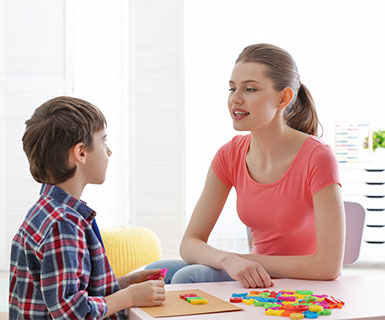
Oral Motor and Pre-Speech Exercises
Oral motor exercises strengthen the muscles required for speech and improve control of the lips, tongue, and jaw. These exercises are especially beneficial for children with unclear speech or delayed verbal skills. Common oral motor activities include:
- Lip movements to improve strength, closure, and control needed for sounds such as “p,” “b,” and “m”.
- Tongue exercises to increase flexibility, coordination, and precise articulation of speech sounds.
- Jaw stability exercises to support proper mouth positioning and improve overall speech clarity.
- Blowing and breathing exercises to develop breath control, airflow, and voice production.
These exercises are often introduced through play-based and engaging activities to maintain the child’s interest and motivation. With regular practice, oral motor exercises help improve awareness of mouth movements, reduce speech effort, and create a strong foundation for clearer speech, better sound formation, and smoother verbal expression.
Sound Awareness and Imitation Exercises
Sound awareness and imitation exercises are a critical step in speech development, especially for children with autism and speech disorders. These exercises help children become more aware of different sounds in their environment and learn how speech sounds are produced. By improving listening skills and sound discrimination, children gradually develop the ability to imitate and produce sounds accurately. Therapy exercises in this stage may focus on:
- Imitating simple vowel and consonant sounds to build awareness of basic speech patterns.
- Repeating syllables such as “ba,” “ma,” and “da” to improve coordination between listening and speaking.
- Practicing frequently used everyday words to encourage functional communication.
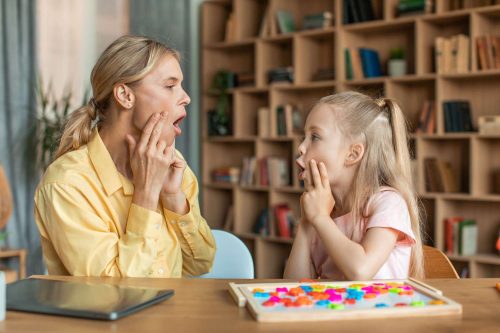
- Using mirrors to help children observe and understand lip, tongue, and jaw movements during speech.
These activities are introduced in a playful and encouraging manner to reduce pressure and frustration. Regular and consistent sound practice helps minimize articulation errors, improve clarity of speech, and build the child’s confidence in using verbal communication across different settings.
Parental involvement is essential for long-term success in speech therapy. Parents are guided on how to practice speech exercises at home during daily routines. Home practice may include:
- Encouraging verbal requests during meals
- Reading and naming objects in storybooks
- Using everyday conversations to model language
- Reinforcing therapy goals through play
Consistent practice helps children generalize skills beyond therapy sessions.
Vocabulary Development Exercises
Building vocabulary allows children to name objects, express needs, and describe actions or feelings. Vocabulary exercises are structured and repetitive to support learning and retention. Vocabulary building may include:
- Naming familiar objects, people, and places to strengthen everyday communication.
- Learning action words related to daily routines such as eating, playing, and dressing.
- Understanding and using emotion-based words to help children express feelings appropriately.
- Matching spoken words with pictures, toys, or real-life objects to reinforce word meaning.
These exercises are often integrated into play and daily interactions, making learning natural and engaging. With regular practice, vocabulary development exercises improve both receptive language (understanding words) and expressive language (using words), helping children communicate more clearly and confidently in different environments.
Sentence Formation and Language Expansion
Once children begin using words consistently, speech therapy focuses on combining words into phrases and sentences. Language expansion exercises involve:
- Teaching two-word and three-word combinations
- Expanding single words into short sentences
- Modeling correct grammar and sentence structure
- Encouraging children to describe experiences and choices
This step improves communication clarity and helps children express complete thoughts.
Social Communication and Pragmatic Language Skills
Social communication and pragmatic language skills are often areas of difficulty for children with autism. These skills involve understanding how, when, and why language is used in social situations, not just the ability to speak words. Speech therapy focuses on helping children use language meaningfully to connect with others, share experiences, and participate in everyday interactions. Key social communication exercises include:
- Turn-taking during conversations and play to encourage reciprocal interaction.
- Making requests and responding to questions in appropriate and socially acceptable ways.
- Maintaining eye contact and joint attention to support shared focus and engagement.
- Understanding facial expressions, body language, and emotions to improve social awareness.
These exercises are practiced through structured activities, role-play, and guided social interactions in a safe and supportive environment. With consistent practice, children develop better social understanding, improved communication confidence, and greater independence, allowing them to participate more comfortably in school, family, and social environments.c
Visual Supports and Alternative Communication Methods
For children who are non-verbal or minimally verbal, visual support and alternative communication methods play a vital role in building effective communication. These approaches help children understand their environment, express needs, and interact with others without the pressure of spoken language. Visual and alternative communication tools are often introduced alongside speech therapy to reduce frustration and encourage active participation. Therapists may use a range of supports, including:
- Picture Exchange Communication System (PECS) to help children communicate wants and needs through picture-based exchanges.
- Visual schedules to support understanding of daily routines and transitions.
- Gesture-based or sign communication to provide an additional way to express ideas and requests.
- Communication boards or assistive devices that allow children to select symbols or words to communicate.
These tools provide structure and clarity, helping children feel more confident and understood. Over time, visual support can also encourage the development of verbal communication while promoting meaningful interaction and independence across different environments.
Parent Training and Home Practice
Parental involvement is essential for long-term success in speech therapy. Parents are guided on how to practice speech exercises at home during daily routines. Home practice may include:
- Encouraging verbal requests during meals
- Reading and naming objects in storybooks
- Using everyday conversations to model language
- Reinforcing therapy goals through play
Consistent practice helps children generalize skills beyond therapy sessions.
Conclusion
Speech therapy exercises for autism and speech disorders require a structured, step-by-step approach that focuses on both speech and language development. From oral motor strengthening to social communication training, each stage plays a vital role in helping children communicate effectively. At Nurturers, speech therapy is individualized, evidence-based, and family-centered, empowering children to build confidence, independence, and meaningful connections through communication.