“My child understands everything but isn’t talking…”
This is one of the most common worries parents have. You may see other children talking more and start wondering if something is wrong. The confusion usually comes down to this—Is your child just a late talker, or is it a speech or language delay? In this blog, we’ll explain the difference in a very simple way so you can understand what’s happening and what you should do next.
What Is a Late Talker?
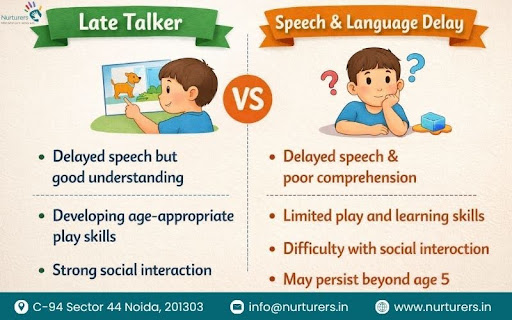
A late talker is simply a toddler (often 18–30 months old) who understands language well but speaks fewer words than expected for their age. In other words, they have a good grasp of language and normal play and thinking skills, but are just slow to start using many words. Research suggests about 13% of two-year-olds are late talkers. The good news is many late talkers catch up on their own – roughly half to two-thirds catch up by preschool age. However, not every late talker “grows out of it.” Experts note that while some late talkers eventually catch up, about 20–30% continue to have language difficulties. So it’s important to watch progress and get advice if you’re concerned.
What Is a Speech or Language Delay?
A speech or language delay is when a child falls behind typical milestones for talking or understanding. (Remember, speech and language are not the same thing: “speech” is the physical act of making sounds and words, while “language” is about understanding and using words to communicate.) A speech delay usually means your child struggles to say sounds or words clearly, even if they understand what you say. A language delay means difficulty understanding others or using words or sentences to express ideas. For example, a child with a language delay might say a few words correctly but only use two-word phrases. A child with a speech delay might use many words but their words are hard to understand. Either way, a speech/language delay often needs support from a professional.
For example:
A child may understand everything but struggle to speak clearly (speech delay), or
A child may not understand instructions or form sentences easily (language delay)
Understanding Basic Speech Milestones
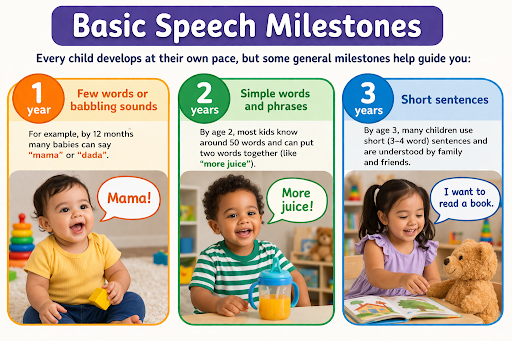
Every child develops at their own pace, but some general milestones help guide you:
- 1 year: Few words or babbling sounds. For example, by 12 months many babies can say “mama” or “dada”.
- 2 years: Simple words and phrases. By age 2, most kids know around 50 words and can put two words together (like “more juice”).
- 3 years: Short sentences. By age 3, many children use short (3–4 word) sentences and are understood by family and friends.
If your child isn’t hitting these basic steps (for example, if they have no words by 18 months or aren’t using short phrases by age 2), it’s a good idea to talk with a doctor or therapist.
When Should You Worry?
It’s true every child develops at their own pace, so don’t panic at the first sign of slow talking. But there are some clear warning signs:
- No gestures by 1 year: Babies usually point or wave by around 12 months. A child who still isn’t gesturing (pointing at things, waving “bye-bye”, or using other gestures) by age 1 should be evaluated.
- No words by about 18 months: By 16–18 months most toddlers say at least a few single words. Not saying any single words by that age is a concern.
- Not following simple instructions by age 2. By 2 years, most children should follow simple requests (like “pick up the ball”). If a child isn’t responding to their name or simple directions by about 2, it’s a red flag.
- No two-word phrases by 2: If by 24–30 months your child still isn’t putting two words together (like “want cookie”), get checked.
- Regression (losing skills): If a child was talking or gesturing and then loses words or social skills, act quickly. Any loss of language skills or social engagement should prompt immediate evaluation.
- In general, if your child misses several of these milestones or you “know something isn’t right,” talk to your pediatrician. One CDC guide sums it up: “You know your child best. Don’t wait. If your child is not meeting milestones, has lost skills…, or you have other concerns, act early
Is It Just Late Talking or Something Else?
It can be hard to tell. Many worried parents wonder if autism or another issue might be involved. The good news is that late talkers usually have no other developmental problems. ASHA (American Speech-Language-Hearing Association) defines late talkers as children whose language is late without any other diagnosed delays. In practice, late talkers generally do use gestures (pointing, waving, etc.) and enjoy playing with others – they just talk later. By contrast, children with autism spectrum disorder often have weaker play and social skills from the start. Pediatric therapists note that most late talkers “still are able to communicate through gestures and body movements” and have strong understanding and play skills compared to children with autism.
That said, every child is different. If your child is a late talker, it doesn’t automatically mean autism, and vice versa. The key is whether your child’s delays are only in talking (late talker) or also in things like understanding, play, or social engagement (language delay or another issue). In any case, it’s fine to mention any concerns about autism to your doctor, but know that many “late talkers” turn out to just need a bit more time or support with language
Common Myths
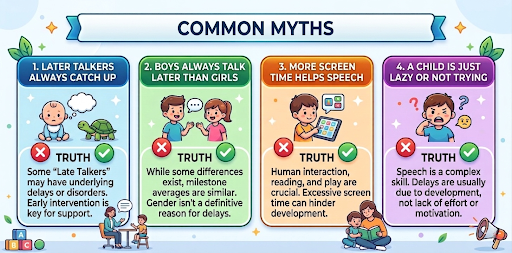
There are lots of misconceptions out there. Here are a few big ones (and why they’re not quite true):
- Boys talk late, so it’s fine: True, statistically boys can be a bit slower at speech on average, but that doesn’t mean you should ignore a boy’s delay. Experts warn that “persistent delays beyond normal age milestones should be addressed,” regardless of gender. Assuming “he’ll catch up” without checking can delay helpful support.
- They’ll talk once they start school: Sometimes kids do seem to “start talking” more around preschool age, but you can’t count on it. Speech experts caution against a pure “wait-and-see” approach. As one specialist puts it, advice to just wait is based on misconceptions – while some late talkers catch up on their own, others do not. Waiting until school means missing valuable early help.
- No need for therapy – they’ll be fine: It’s true many kids eventually catch up, but skipping early support can make things harder. In fact, therapists agree: the earlier you seek help, the better. One speech center notes that children who get help before age 3 tend to have much better communication, learning, and social outcomes. In short, early guidance and therapy (if needed) can make learning to talk easier and prevent frustration later.
Why Early Help Matters
Getting support early can set your child up for success. For one thing, research shows that young brains are very open to learning – early intervention can help a late talker catch up faster. One study found that 50–70% of late talkers who receive timely help are speaking normally by preschool age. Another review reports that children who start speech therapy by age 3 often make better long-term gains than if they wait. In practice, early help means easier learning later. When a child’s speech improves sooner, they communicate better with family and teachers, which reduces frustration and boosts confidence as they grow.
How You Can Help at Home
You play a huge role in helping your child learn language. Here are some everyday strategies (simple things, not extra “therapy”):
- Talk and sing often. Describe what you’re doing (e.g. “Mommy is pouring milk”) and use simple words. The more you narrate daily routines, the more language your child hears.
- Read together. Even 5–10 minutes of reading a simple book each day makes a big difference. Point at pictures and name objects; ask questions (“Where’s the dog?”) in a fun way.
- Encourage imitation. Play games like copying sounds, clapping, or simple actions. When your child makes a sound or word, repeat it back clearly with the correct word. For example, if they say “ba-ba” for bottle, you say “Yes, you want your bottle” to model the right word.
- Give lots of time. After you say something, pause and wait – even a few extra seconds. This gives your child a chance to respond or try a word. It can feel slow, but it helps them practice communicating.
- Play together. Use your child’s interests (toys, blocks, bath time) to encourage talking. If they point at a toy, say its name or a short phrase about it. Praise attempts to communicate, even if the words aren’t perfect.
These simple steps — talking, listening, and reading together — create a rich language environment that helps any child (especially late talkers) learn to speak.
When to See a Speech Therapist
If you’re ever unsure, don’t wait to ask for help. A speech-language pathologist (SLP) can tell you for sure if your child’s speech is just on the slow side or needs intervention. In fact, experts strongly advise contacting an SLP sooner rather than later if you’re concerned. The Hanen Centre (a leading language organization) recommends that any toddler with very limited vocabulary see a speech therapist and get a hearing check – even if hearing seems fine. Early assessment means any therapy can start when it’s most effective. Remember: getting support early often leads to better results than waiting.
Quick FAQ
Is my child just a late bloomer?
Maybe – every child grows at their own pace. But if your child is behind on major milestones (no words by 18 months, for example), it’s wise to check. Experts note that advice like “he’ll catch up on his own” can be misleading: some late talkers catch up later, but others do not. So while many late bloomers are just fine, it’s best to talk to your pediatrician if you have doubts.
Why does my child understand but not talk?
This is exactly the classic late-talker pattern: good comprehension (“I know what you mean”) with delayed expressive speech. Late talkers often seem tuned-in, but just aren’t using words yet. It means watching and supporting expressive language development carefully.
What age is concerning?
By about 18 months, most toddlers say at least a few single words. By 2 years, they usually combine words. If your child isn’t saying any words by 18 months, or isn’t putting words together by age 2, those are red flags. In practice, we start to worry when milestones pile up: for instance, no words by 18 months and no gestures by 1 year, or no two-word phrases by 2, definitely warrant an evaluation.
Conclusion
Every child grows and develops in their own way, and some may start talking a little later than others. However, it’s important to trust your instincts. If something doesn’t feel right, it’s always a good idea to speak with a doctor or a speech therapist—you understand your child better than anyone. As experts often advise, don’t wait if your child is missing milestones or losing skills—early action is important. Taking timely steps can greatly support your child in building strong communication skills and help you enjoy those special moments when they begin to speak with confidence.
With the right guidance from experienced professionals like Swati Suri and the team at Nurturers, parents can move forward with clarity and confidence in supporting their child’s communication journey.