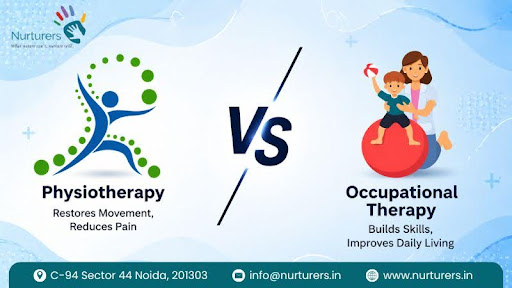
Many people feel confused when choosing between therapies that support recovery and daily functioning. The debate around occupational therapy vs physiotherapy is common—especially for parents, caregivers, and individuals dealing with injuries or developmental concerns.
Both therapies play a vital role in improving quality of life, but they focus on different aspects of health and independence. In this guide, we’ll break down the differences in simple terms, helping you understand which therapy might be the right fit for your needs.
What Is Occupational Therapy?
Occupational therapy is all about helping people manage their everyday life more easily and independently. Here, “occupation” doesn’t mean a job—it simply refers to daily activities like getting dressed, eating, writing, playing, or even focusing in school.
An occupational therapist looks beyond just the physical issue. They try to understand how a person functions in real life and what’s stopping them from doing simple day-to-day tasks comfortably.
Goals of Occupational Therapy
The main aim of occupational therapy is to make daily life smoother and more independent. It helps people:
- Handle routine tasks without constant help
- Improve hand skills needed for writing, eating, or dressing
- Stay focused and organized during activities
- Manage sensory sensitivities (like being too sensitive to noise or touch)
Who Needs Occupational Therapy?
Occupational therapy can support both children and adults. For example:
- A child who struggles to hold a pencil or sit still in class
- A child with developmental delays or sensory issues
- An adult recovering from a stroke who finds daily tasks difficult
- Anyone who feels stuck or dependent in their everyday routine
Common Interventions
Instead of just exercises, occupational therapy uses real-life activities to build skills:
- Practicing daily routines like dressing, eating, or brushing teeth
- Fun hand-strengthening activities like playing with clay or puzzles
- Sensory activities to help the brain respond better to different stimuli
- Simple strategies to improve focus and coordination
Real-Life Example
Think of a child who avoids writing because it feels difficult. An occupational therapist won’t just ask them to write again and again. Instead, they might start with fun activities like squeezing clay, using thick crayons, or playing games that build hand strength. Slowly, writing becomes easier and less frustrating.

What Is Physiotherapy?
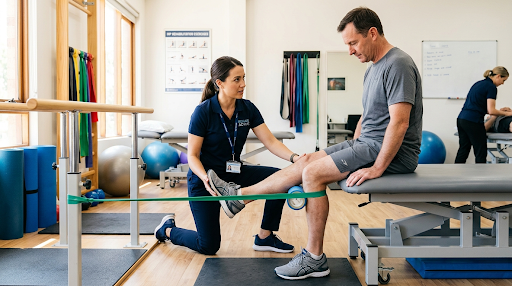
Physiotherapy focuses on improving how your body moves. It’s mainly about reducing pain, building strength, and helping you move freely without discomfort.
If your body feels stiff, weak, or painful—this is where physiotherapy comes in. It works on muscles, joints, and overall physical function so you can get back to your normal routine.
Goals of Physiotherapy
Physiotherapy aims to get your body moving better again. It helps to:
- Reduce pain and stiffness
- Improve movement and flexibility
- Build muscle strength
- Support recovery after injury or surgery
Who Needs Physiotherapy?
Physiotherapy is helpful for many situations, such as:
- Someone with back pain or a sports injury
- A person recovering after surgery or an accident
- Elderly individuals who feel unsteady while walking
- Anyone facing difficulty in movement or physical activities
Common Interventions
Physiotherapy usually involves physical and movement-based techniques like:
- Stretching and strengthening exercises
- Hands-on therapy to relieve pain and improve mobility
- Posture correction to prevent strain
- Balance and walking training
Real-Life Example
Imagine someone who has injured their ankle and now finds it painful to walk. A physiotherapist will guide them through specific exercises, gradually helping them regain strength and confidence so they can walk normally again.
Similarities Between Occupational Therapy and Physiotherapy
Even though they focus on different things, both therapies are working toward the same bigger goal—helping people live a better, more comfortable life.
- Both focus on improving quality of life
- Both use structured, proven methods
- Both support recovery and long-term improvement
- Both are suitable for children as well as adults
- Both often work together for better results
Real-Life Example
Let’s say someone is recovering from a stroke.
A physiotherapist helps them regain movement in their arm or leg, while an occupational therapist helps them relearn everyday tasks like eating or getting dressed.
So, while one helps the body move better, the other helps the person live better.
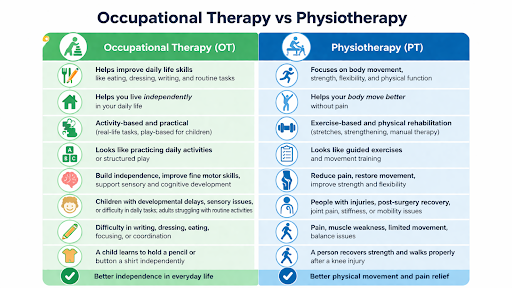
Key Differences: Occupational Therapy vs Physiotherapy
Aspect | Occupational Therapy (OT) | Physiotherapy (PT) |
Focus Area | Helps improve daily life skills like eating, dressing, writing, and routine tasks | Focuses on body movement, strength, flexibility, and physical function |
Simple Understanding | Helps you live independently in your daily life | Helps your body move better without pain |
Treatment Approach | Activity-based and practical (real-life tasks, play-based for children) | Exercise-based and physical rehabilitation (stretches, strengthening, manual therapy) |
Session Style | Looks like practicing daily activities or structured play | Looks like guided exercises and movement training |
Main Goals | Build independence, improve fine motor skills, support sensory and cognitive development | Reduce pain, restore movement, improve strength and flexibility |
Who Needs It | Children with developmental delays, sensory issues, or difficulty in daily tasks; adults struggling with routine activities | People with injuries, post-surgery recovery, joint pain, stiffness, or mobility issues |
Type of Problems Addressed | Difficulty in writing, dressing, eating, focusing, or coordination | Pain, muscle weakness, limited movement, balance issues |
Real-Life Example | A child learns to hold a pencil or button a shirt independently | A person recovers strength and walks properly after a knee injury |
End Result | Better independence in everyday life | Better physical movement and pain relief |
When to Choose Occupational Therapy vs Physiotherapy
Choosing between occupational therapy vs physiotherapy depends on what kind of difficulty you or your child is facing.
Choose Occupational Therapy if:
- Daily activities feel challenging (like dressing, eating, or writing)
- A child has developmental delays or struggles in school tasks
- There are sensory issues (overreaction or underreaction to sounds, touch, etc.)
- Fine motor skills (like holding a pencil or buttoning clothes) need improvement
- There are coordination or attention difficulties
👉 Example: A child who understands everything but struggles to write or sit still may benefit from occupational therapy.
Choose Physiotherapy if:
- You are experiencing pain, stiffness, or physical discomfort
- There is difficulty in walking, standing, or moving normally
- You are recovering from surgery, injury, or an accident
- Muscle strength, balance, or flexibility needs improvement
Example: Someone with back pain or a sports injury would benefit more from physiotherapy.
Still Confused?
It’s completely normal to feel unsure. A professional assessment can help identify the exact need and guide you toward the right therapy.
Can You Need Both Therapies?
Yes—many people actually benefit from a combination of both.
In real life, problems are often not just physical or just functional—they are a mix of both. That’s where occupational therapy and physiotherapy work best together.
Real-Life Examples
- Stroke Recovery:
Physiotherapy helps regain strength and movement, while occupational therapy helps relearn daily activities like eating, dressing, or writing. - Child Development:
Physiotherapy may improve posture, balance, and strength, while occupational therapy helps with focus, coordination, and school-related skills.
At Nurturers, founded by Swati Suri, a special educator with 10+ years of experience, therapy plans are personalized based on each individual’s specific needs. The focus is on targeted, skill-based interventions that support development, independence, and everyday functioning.
Conclusion
Understanding the difference between occupational therapy vs physiotherapy can make a big difference when choosing the right support.
Physiotherapy focuses on helping your body move better and recover from pain, while occupational therapy helps you manage daily life more independently and confidently.
Both therapies are equally important—and in many cases, they work even better together.
If you or your child are facing any challenges, don’t hesitate to seek professional guidance. Early support and the right approach can truly improve quality of life and long-term outcomes.