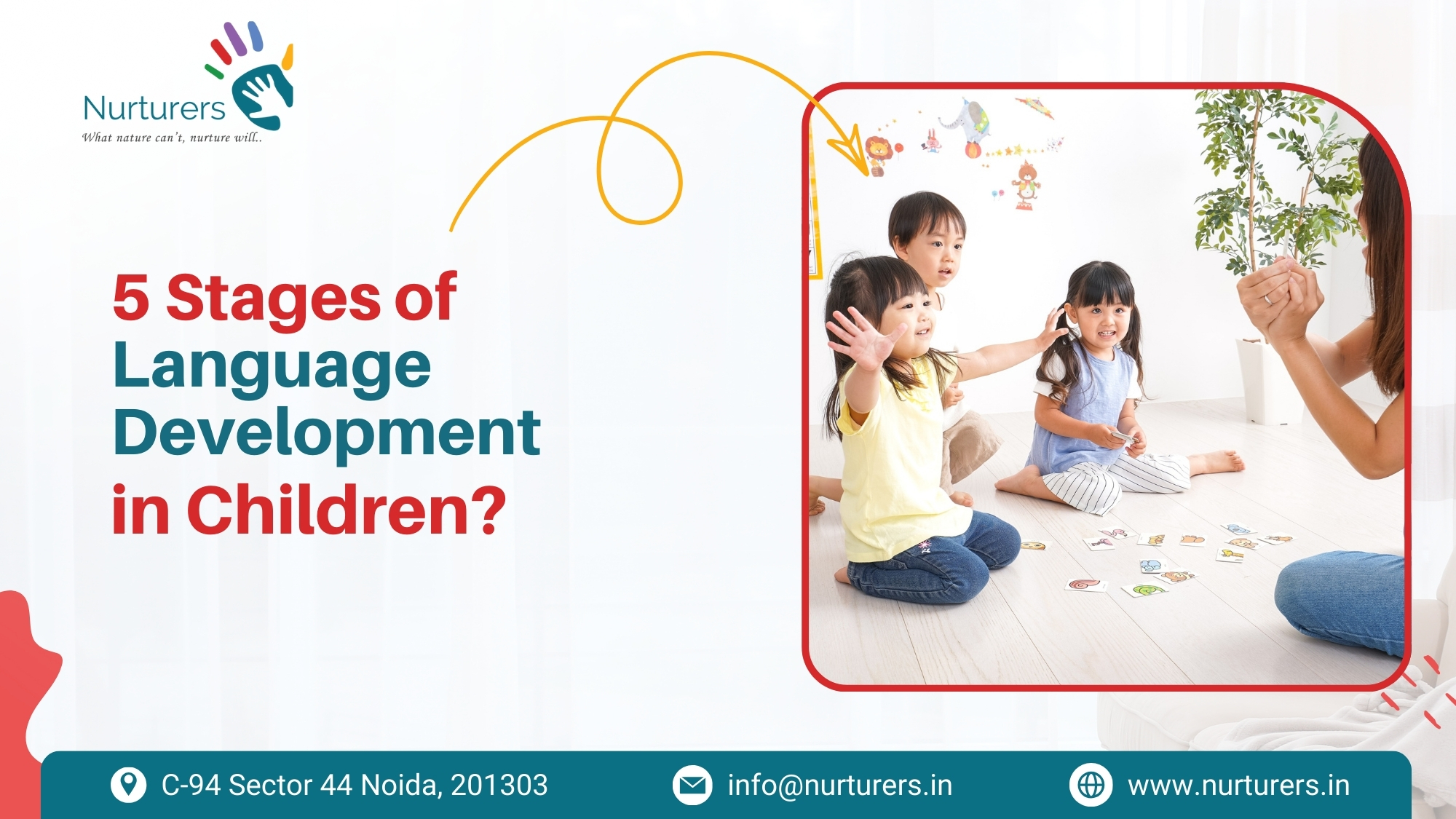
Language development in children is a gradual process that begins from birth and continues through early childhood, shaping how a child understands, expresses, and communicates with the world. It includes learning to listen, respond, use gestures, form words, build sentences, and engage in meaningful conversations. Each child progresses through well-defined child language development stages that reflect their growing brain, social interactions, and exposure to language at home and school.
Understanding what are the 5 stages of language development helps parents and educators identify whether a child is developing typically or may need early support. From the pre-linguistic stage, where babies communicate through cries and coos, to the complex linguistic stage, where children can express thoughts clearly, every phase contributes to building strong language and communication skills.
What is Language Development in Children?
Language development in children is the natural process through which a child learns to understand, communicate, and express ideas using sounds, gestures, words, and sentences. It begins from birth when babies start responding to voices, and it continues as they progress through stages like babbling, first words, short phrases, and meaningful conversations. This development includes both receptive language (understanding words, instructions, and sounds) and expressive language (speaking, gesturing, and forming sentences). Language grows through interaction, daily communication, play, and exposure to conversations. Strong language development is essential because it supports thinking, social skills, emotional expression, academic learning, and overall child growth and development.
Stage 1 — Pre-linguistic or Foundation Stage (Birth to about 12 months)
In the earliest months, babies are busy building the foundation for language even before they say their first word. This pre-linguistic stage includes crying to communicate needs, then cooing (soft vowel sounds), and later canonical babbling (repeated syllables like “ba-ba” or “ma-ma”). Babies also learn turn-taking by watching faces and waiting for responses, and they begin to use gestures — reaching, pointing, and waving — which are important preludes to spoken language. Caregivers support this stage by responding to sounds and gestures, narrating what they’re doing, and creating lots of face-to-face back-and-forth moments.
Stage 2 — One-Word or Holophrase Stage (About 12 to 18/24 months)
Around the first birthday many children enter the one-word stage where a single word can carry a whole thought—“milk” might mean “I want milk,” or “dog” might point out a pet. Vocabulary grows slowly at first, then accelerates. Pronunciation is often simplified, but the child’s understanding of language (receptive language) is usually ahead of what they can say. To encourage vocabulary during this child language development stage, label objects and actions consistently, offer choices (“Do you want the apple or the banana?”), and read simple picture books while pointing to images.
Stage 3 — Two-Word and Telegraphic Speech Stage (About 18 to 24 months)
The two-word stage marks an important leap: children begin combining words in short phrases such as “more milk,” “mama go,” or “big truck.” These telegraphic utterances omit small grammatical words but show clear intent and growing grammar awareness. This stage is critical for developing sentence structure. Adults can support progress by expanding what the child says (if the child says “doggie run,” respond with “Yes, the doggie is running fast!”), asking simple questions, and encouraging imitation through play.
Stage 4 — Early Multiword and Grammar Development (About 2 to 3 years)
Between two and three years, children move into early multiword sentences and begin using grammatical markers like plurals, basic verb tenses, and pronouns. Vocabulary explodes and children start to produce longer, more complex utterances such as “I want my blue shoes” or “She went to the park.” During this stage of language development, pretend play becomes richer and children begin to tell simple sequences of events. Support at this stage includes modeling correct grammar without over-correcting, offering open-ended prompts (“Tell me what happened next”), and continuing to read daily with slightly more complex stories.
Stage 5 — Refinement, Narrative Skills, and Social Language (About 3 to 5+ years)
From about three years onward, children refine grammar, expand vocabulary rapidly, and develop conversational skills and storytelling. They learn to use language for different social purposes—asking, explaining, persuading—and become better at taking turns and staying on topic. Phonological clarity improves, and many children are mostly intelligible by age four to five. This later stage of child language development stages also prepares children for literacy: rhyming, letter awareness, and sound play become important. Parents and educators support this phase by encouraging complex storytelling, asking the child to describe events in order, introducing new words in context, and engaging in activities that connect spoken language with books and print.
Stages of Language Development Chart
Stage (approx. age) | Typical skills observed | How to support |
Pre-linguistic (0–12 months) | Cooing, babbling, gestures, turn-taking | Respond to sounds, face-to-face play, name objects |
One-word (12–18/24 months) | Single words, strong comprehension | Label objects, read picture books, give choices |
Two-word (18–24 months) | Two-word phrases, telegraphic speech | Expand phrases, model slightly longer sentences |
Early multiword (2–3 years) | Simple grammar, longer sentences | Encourage play narratives, read daily, ask “what”/“why” |
Refinement (3–5+ years) | Complex sentences, storytelling, pragmatics | Storytelling, vocabulary games, link to early literacy |
Which Therapies Help Children Improve Language Development?
Several therapies support language development depending on a child’s needs. Speech Therapy helps children improve vocabulary, clarity, and sentence building. Occupational Therapy supports attention, sensory needs, and play readiness. For social communication difficulties, ABA Therapy, Play Therapy, and Social Skills Training help develop eye contact, turn-taking, gestures, and interaction skills.
Key Therapies for Language Development
- Speech Therapy (ST): Speech Therapy Helps children improve vocabulary, sound production, sentence formation, and overall speech clarity. Therapists use picture cards, imitation tasks, and language-building activities to strengthen expressive and receptive language skills.
- Occupational Therapy (OT): Supports children who have difficulty with attention, sensory processing, or play engagement. Occupational Therapy improves sitting tolerance, focus, motor planning, and sensory regulation, which directly enhance a child’s readiness to learn language.
- ABA Therapy (Applied Behavior Analysis): Highly effective for children with autism and communication delays. ABA builds early learning skills like imitation, requesting, labeling objects, eye contact, and social interaction through structured behavior-based methods.
- Social Skills Training: Improves interaction skills such as eye contact, turn-taking, greetings, understanding social cues, and participating in group conversations. It is especially useful for children who struggle with social communication or pragmatic language.
Conclusion
Understanding what are the 5 stages of language development helps parents support their child at the right time. Each stage — from sounds and babbling to full sentences — plays a unique role in shaping communication skills. By using the child language development stages chart and practicing daily interaction, storytelling, and reading, parents can strengthen their child’s language journey.