Listening skills are one of the most essential foundations of a child’s development. Before a child learns to read, write, or express ideas clearly, they first learn to listen. Listening is not simply the act of hearing sounds. It is a complex brain process that involves attention, understanding, memory, interpretation, and response.
Many academic struggles, behavioral concerns, and communication delays are directly linked to weak listening abilities. At Nurturers, we frequently observe that once listening skills improve, children show noticeable progress in speech clarity, classroom performance, social confidence, and emotional regulation.
What Are Listening Skills?
Listening skills refer to the ability to accurately receive spoken information, process it in the brain, understand its meaning, and respond appropriately. It requires coordination between hearing ability, attention span, working memory, and language comprehension. It is important to understand the difference between hearing and listening. Listening is active and intentional. A child may pass a hearing test but still struggle with listening because listening involves higher-level brain processing. Listening includes:
- Paying focused attention to the speaker
- Filtering out background distractions
- Understanding vocabulary and sentence structure
- Interpreting tone, emotions, and intent
- Remembering information
- Responding meaningfully
These skills begin developing in infancy and continue strengthening through early childhood and school years.
The Brain Science Behind Listening
Listening is a neurological process. When a child listens, sound waves enter the ear, but understanding happens in the brain. The auditory cortex processes sound, while other brain areas interpret language, meaning, and emotional tone. Listening also depends on:
- Auditory processing skills
- Working memory
- Attention control
- Language comprehension
- Executive functioning
If any of these systems are weak, children may struggle with following instructions, understanding lessons, or responding appropriately. For example, a child with poor auditory processing may hear the teacher’s voice but may not correctly decode or organize the information.
Different Types of Listening Skills in Children
Listening is not a single ability. It includes several skills that develop gradually and support different areas of a child’s growth.
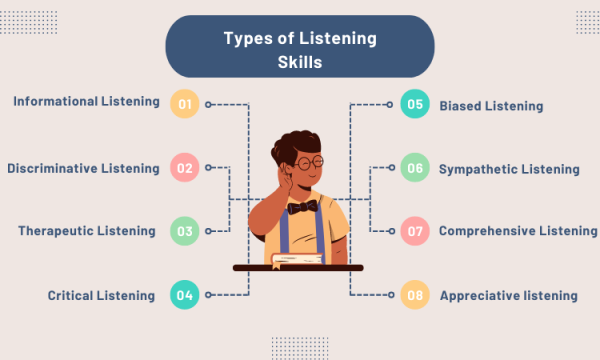
- Attentive listening helps children stay focused on the speaker without getting distracted. This skill is essential in classrooms where children must concentrate despite background noise.
- Active listening involves responding, asking questions, and participating in conversations. It encourages confidence and better social interaction.
- Comprehension listening allows children to understand instructions, stories, and lesson concepts. This skill directly supports academic performance and language development.
- Critical listening helps older children analyze information, think logically, and form opinions based on what they hear.
- Empathetic listening supports emotional understanding. It helps children recognize feelings through tone and expressions, strengthening friendships and social bonds.
Each type of listening plays an important role in academic success, communication, and healthy relationships.
Why Are Listening Skills Important for Academic Success?
Listening is the foundation of classroom learning. Most teaching happens verbally. Children must listen to instructions, explanations, discussions, and feedback throughout the day. Strong listening skills support:
- Following multi-step instructions
- Understanding lesson concepts
- Improving reading readiness
- Enhancing spelling and writing
- Expanding vocabulary
- Strengthening comprehension skills
Children who listen well can complete tasks independently and require fewer repetitions. This builds confidence and academic independence. In contrast, children with weak listening skills may appear inattentive, forget instructions, or struggle to keep up with classroom expectations.
Listening and Speech Development
Speech and language development depend heavily on listening. Children learn new words by hearing them repeatedly in meaningful contexts. They learn grammar by listening to sentence patterns. If listening skills are weak, children may experience:
- Delayed speech development
- Limited vocabulary
- Difficulty forming sentences
- Trouble answering questions
- Mispronunciation due to poor sound discrimination
At Nurturers, speech therapy programs often begin with strengthening listening and auditory discrimination before focusing on expressive speech.
How Listening Skills Affect Social and Emotional Growth?
Listening plays a key role in social development. Children who listen well can understand social rules, follow conversations, and respond appropriately to peers. Good listening skills help children:
- Take turns during conversation
- Understand emotions through tone of voice
- Follow group rules
- Build friendships
- Develop empathy
Poor listening skills may lead to misunderstandings, frustration, or difficulty maintaining peer relationships. Some children may be labeled as inattentive or disobedient when the underlying issue is actually weak listening ability.
Signs That a Child May Have Listening Difficulties
Parents and teachers should look for early indicators of listening challenges. Common signs include:
- Frequently saying “What?” or asking for repetition
- Difficulty following multi-step instructions
- Appearing distracted even in quiet environments
- Forgetting verbal information quickly
- Struggling with story comprehension
- Incomplete classroom work due to misunderstanding directions
- Difficulty distinguishing similar sounds
These signs may be linked to attention issues, auditory processing difficulties, language delays, or sensory challenges.
Common Causes of Listening Difficulties
Listening challenges can arise from different developmental and cognitive factors. Because listening involves attention, memory, language understanding, and sensory regulation, difficulties may appear when any of these areas are affected.
- Auditory processing disorder can make it hard for a child to correctly interpret sounds, even if their hearing is normal.
- Attention deficit difficulties may reduce focus, causing children to miss or forget verbal instructions.
- Speech and language delays can limit understanding of vocabulary and sentence structure.
- Sensory processing challenges may make background noise overwhelming, affecting concentration.
- Autism spectrum conditions can influence how children understand language and social cues..
Identifying the root cause helps professionals create the right intervention plan and provide effective support.
Practical Strategies to Improve Listening Skills
Listening skills can be strengthened with structured practice and consistent support at home and school. Effective strategies include:
- Giving short, clear instructions
- Breaking tasks into smaller steps
- Asking the child to repeat instructions
- Maintaining eye contact while speaking
- Reducing background noise during conversations
- Reading stories daily and asking questions
- Playing listening-based games like “Simon Says”
- Encouraging turn-taking conversations
Consistency is key. Small daily practices can significantly improve listening over time.
The Role of Professional Support
When listening difficulties persist, professional assessment can identify the underlying cause. Early intervention prevents academic delays and improves long-term outcomes. At Nurturers, individualized therapy programs focus on:
- Auditory processing training
- Speech and language therapy
- Attention-building activities
- Sensory regulation techniques
- Cognitive skill development
Therapy is designed to strengthen the foundation so that children can process, understand, and respond confidently in academic and social settings.
Conclusion
Listening skills are not just about hearing words. They are the foundation of learning, communication, behavior, and emotional development. Strong listening abilities help children succeed in school, build healthy relationships, and develop self-confidence. When children struggle with listening, it can affect every area of life. However, with early identification, structured support, and professional guidance, listening skills can be significantly improved.