
Every parent watches their baby grow with wonder and hope — every smile, every sound, every small movement feels special. But when development seems a little different, it’s natural for questions to arise. This is where early intervention becomes one of the most powerful tools for families. This guide will help you understand the first signs of delay and how early intervention support can create meaningful, lasting progress for your child.

What Is Early Intervention?
Early intervention is a structured system of therapies and support designed for young children, usually from birth to 6 years, who show signs of developmental delay. It focuses on building essential skills during the most important years of brain growth.
If you’re wondering what is early intervention program, it refers to a coordinated plan that may include speech therapy, occupational therapy, special education, and behavioral support. These services are typically provided at an early intervention centre, where specialists assess your child and create a plan tailored to their needs.
Why Is Early Intervention So Important for Your Baby?
The first three years of life are a period of rapid brain development. During this time, early intervention can significantly influence how your child learns, communicates, and interacts with the world.
According to the CDC, about 1 in 6 children experience developmental challenges. Children who receive early intervention support tend to show better outcomes in language development, motor skills, and social development. The importance of early intervention lies in acting early — you don’t need to wait for a diagnosis if you have concerns.
Delays that are ignored can affect other areas over time. Taking timely action through early intervention gives your child the best chance to build strong foundations.
First Signs of Developmental Delay in Babies — Age-by-Age Guide
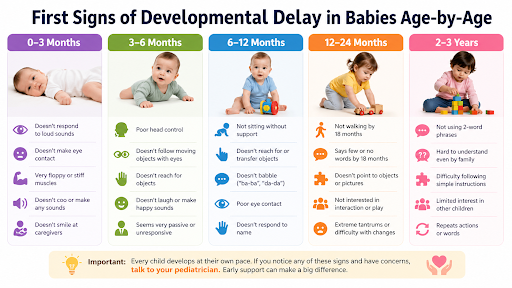
Understanding milestones by age can help you notice early signs more clearly.
0–3 Months
- Does not respond to loud sounds
- Limited eye contact or does not follow faces
- Rarely smiles or shows expressions
- Muscles feel unusually stiff or floppy
3–6 Months
- Does not reach for objects
- No cooing or babbling sounds
- Limited interest in caregivers
- Difficulty holding head up
6–12 Months
- No babbling or gestures by 9 months
- Does not respond to their name
- Not sitting with or without support
- Limited interest in games like peek-a-boo
12–24 Months
- No single words by 16 months
- Not walking independently by 18 months
- Loss of previously learned skills
- Avoids eye contact or interaction
2–3 Years
- Vocabulary under 50 words by age 2
- No two-word phrases
- Difficulty following instructions
- Limited pretend play
If your child shows one or more of these signs, it does not mean something is definitely wrong. However, it does mean an evaluation can help. Early intervention support works best when started as soon as concerns arise.
What Are the Different Areas of Development Affected by Delays?
Your child’s development doesn’t happen in just one area — it grows across many skills that work together. Sometimes, a delay may show up in one area, or you might notice small challenges across a few.
Speech and Language Development — Your child may find it hard to express needs, use fewer words than expected, or struggle to understand simple instructions.
Motor Development — You might notice delays in sitting, crawling, walking, or using their hands for everyday activities like holding toys or feeding.
Cognitive Development — This includes how your child learns, pays attention, and solves simple problems during play or daily routines.
Social and Emotional Development — Some children may avoid eye contact, show less interest in people, or have difficulty managing emotions.
Sensory Processing — Your child may react strongly (or very little) to sounds, textures, lights, or touch, which can affect behavior and comfort.
Every child is different. Some may need support in just one area, while others may need help across multiple skills. A good early intervention centre can look at the complete picture and guide you on the right next steps.
What Is an Early Intervention Program and What Does It Include?
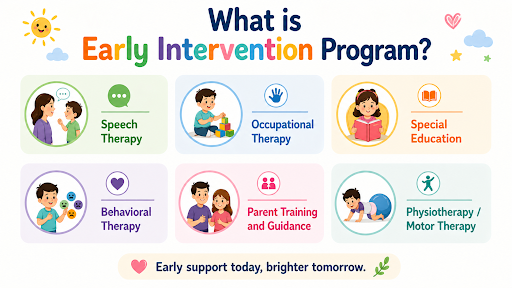
If you’re wondering what is early intervention program, think of it as a step-by-step support plan created just for your child. It focuses on helping them build important skills in a way that feels natural, engaging, and suited to their pace.
Speech Therapy — Helps your child communicate better, understand language, and connect with others.
Occupational Therapy — Supports everyday skills like holding objects, eating, playing, and managing sensory sensitivities.
Special Education — Builds early learning skills such as attention, understanding, and readiness for school.
Behavioral Therapy — Helps your child manage emotions, improve focus, and develop positive behaviors.
Parent Training and Guidance — Gives you simple, practical ways to support your child’s progress at home.
Physiotherapy / Motor Therapy — Strengthens movement skills like sitting, walking, balance, and coordination.
At a supportive early intervention centre like Nurturers, these therapies are not done separately. They are thoughtfully combined into one personalized plan, so your child gets the right support in the right way.
Real Guidance for Parents: What You Actually Need to Know
Trust your instincts — they matter more than you think
You see your child every day in ways no professional ever will. If something feels “a little off,” even if others say “they’ll grow out of it,” it’s okay to take that feeling seriously. Early intervention often begins with a parent simply noticing small differences.
Don’t compare too much — but don’t ignore patterns either
It’s natural to compare your child with others. One child may walk early, another may talk later. That’s normal.
But if you consistently notice gaps — like your child not responding, not communicating, or not engaging — it’s worth exploring further instead of waiting it out.
Waiting rarely helps — but early support always does
One of the biggest mistakes parents are told is: “Let’s wait and watch.”
In reality, early intervention works best before delays become more noticeable. Starting support early does not label your child — it simply gives them the help they need at the right time.
Small daily interactions make a big difference
You don’t need complicated techniques. What matters most is how you interact with your child every day.
- Talk to your child during routine activities (feeding, bathing, dressing)
- Respond to their sounds, gestures, and attempts to communicate
- Get down to their level and make eye contact
- Repeat words slowly and clearly
- Turn playtime into learning time (without pressure)
Consistency at home strengthens everything they learn through early intervention support.
Screen time can quietly slow development
Many parents don’t realize how much passive screen time affects communication and attention.
- Avoid screens for children under 2 years
- For older toddlers, keep it minimal and supervised
- Replace screen time with interactive play and conversation
Children learn best from people, not screens.
Progress may be slow — and that’s okay
Development is not a straight line. Some weeks you’ll see big changes, and other times it may feel like nothing is happening.
That doesn’t mean it’s not working. Early intervention focuses on building strong foundations, even if progress feels gradual.
You don’t need a diagnosis to seek help
This is one of the most important things parents should know.
You don’t have to wait for a label or diagnosis to start early intervention. If there are concerns, an assessment at a trusted early intervention centre can guide you on what your child needs.
Be involved — you are part of the therapy
Therapy doesn’t just happen in a session room. The biggest progress happens at home.
At Nurturers, parents are guided on:
- How to communicate better with their child
- How to handle challenging behaviors
- How to build routines that support development
Your involvement makes a powerful difference.
Every child’s journey is unique
Avoid thinking in terms of “normal vs delayed.” Instead, think in terms of support and growth.
Some children just need a little guidance. Others may need more structured support. Early intervention simply ensures your child gets what works best for them.
The earlier you act, the easier it gets
Delays don’t disappear on their own — they either improve with support or become harder to manage later.
Taking action early doesn’t mean something is wrong. It means you’re giving your child the strongest possible start.
A Gentle Reminder for Parents
You are not expected to have all the answers. Feeling confused, worried, or unsure is part of parenting.
What matters is this:
When you notice, you act.
When you act early, you create opportunities.
At Nurturers, families are supported with care, clarity, and personalized early intervention programs designed for real-life progress — not just clinical goals.
If you ever feel unsure about your child’s development, it’s always okay to ask questions and seek guidance. That one step can make a lifelong difference.
Conclusion
Early intervention is one of the most valuable steps you can take for your child’s development. Recognizing early signs and acting without delay can create long-term positive outcomes. At Nurturers, our experienced team supports families with personalized care designed around each child’s needs. If you have concerns, reach out today and explore how early intervention support can help your child grow with confidence.